




Char Dham Yatra in Uttarakhand is a journey for the upliftment of soul and innermost self. Located in the Garhwal Himalaya ranges in Uttarakhand, these are the four most sacred Hindu shrines that draw devotees from India and around the world. The purpose of this sacred journey is to attain salvation, or moksha, the ultimate state of liberation in Hinduism. The 4 Dham temples hold immense significance in Hindu mythology. 4 Dham Yatra is a pious pilgrimage tour to sacred Badrinath (abode of Lord Vishnu), Kedarnath (abode of Lord Shiva), Gangotri (abode of goddess Ganga) and Yamunotri (abode of goddess Yamuna) Shrines. There is another Char Dham, which consists of four holy sites scattered all over India. Established by Adi Shankaracharya, these are Badrinath in Uttarakhand, Dwarka in Gujarat, Puri in Odisha and Rameswaram in Tamil Nadu.
Char Dham Yatra
The Char Dham, also referred to as “the four abodes”, is the journey up the mountains to the four sacred temples in the north-Indian state of Uttarakhand. It is also sometimes called as Chhota Char Dham to differentiate it from the bigger circuit of Char Dham sites. The four temples that comprise Char Dham are: Yamunotri Dham, Gangotri Dham, Badrinath Dham and Kedarnath Dham. Each of these temples has scintillating myths associated with them, which give them immense religious importance.
Trip Highlights
- Trip Highlights 1
- Trip Highlights 2
- Trip Highlights 3
- Trip Highlights 4
- Trip Highlights 5
Itinerary
Pickup from Haridwar Railway Station / Doiwala Airport, later drive to Uttarkashi. Arrive Uttarkashi, visit Vishwanath Temple & others. Later Check in Hotel. Rest day at leisure. Night Halt.
Uttarkashi: Situated at the bank of river Bhagirathi. The temple of Lord Vishwanath is located here where a massive iron trident is erected.
We proceed to Gangotri (3048 mts), enroute we enjoy picturesque Harsil village, Bhagirathi River and the most magnificent view of the Himalayas. After Gangotri Darshan we return to Uttarkashi. Oernight stay at Uttarkashi.
Gangotri Temple: The temple, constructed by the Gorkha General Amar Singh Thapa in the 18th Century, is situated on the right bank of Bhagirathi.
Submerged Shivling: Submerged in the river, this natural rock Shivling is the place where, according to mythology Lord Shiva sat when he received the Ganga in his matted lock. It is visible in winter months when water level decreases.
Kedar Ganga Sangam: Around 100 Yards from the Ganga Temple flows the river Kedar Ganga. Starting from the Kedar Valle, this river meets the Bhagirathi on its left bank.
Early morning, drive straight to Guptkashi. Check in Hotel, night halt.
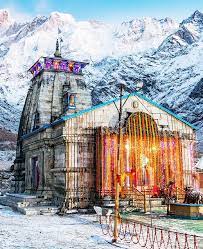
Morning drive to Gaurikund, Trek start from Gaurikund to Kedarnath (3584 mts) on foot or on by pony / Doli. Tour members should carry personal medicines, heavy woolen, toiletries and clothes for an overnight halt at Kedarnath. Check in Hotel. Later visit Kedarnath Temple. Night halt.
Gaurikund: At a distance of 5kms from Sonprayag and at an altitude of 1982 meters., one can take bath in the hot water pond here and visit the Gauri Temple. This is the place where Goddess Parvathi meditated to attain Lord Shiva. It is the base for a trek to Kedarnath.
Kedarnath: The Kedarnath shrine, one of the 12 jyotirlingas of Lord Shiva, is a scenic spot situated, against the backdrop of the majestic Kedarnath range. Kedar is another name of Lord Shiva, the protector and the destroyer. According to legend, the Pandavas after having won over the Kaurava in the Kurukshetra war, felt guilty of having killed their own brothers and sought the blessings of Lord Shiva for redemption. He eluded them repeatedly and while fleeing took refuge at Kedarnath in the form of a bull. On being followed he dived into the ground, leaving his hump on the surface. The r! emaining portions of Lord Shiva appeared at four other places and are worshipped there as his manifestations. The arms appeared at Tungnath, the face at Rudranath, the belly at Madhmaheshwar and his locks (hair) with head at Kalpeshwar. Kedarnath and the four above-mentioned shrines are treated as Panch Kedar
Early morning, after Temple Darshan trek down to Gaurikund. Later, drive to Rudraprayag via Guptkashi. Check in Hotel at Rudraprayag. Night Halt.
Rudraprayag: It is the confluence of river Mandakini and river Alaknanda
Drive to Badrinath via Joshimath. Check in Hotel. Later visit Badrinath Temple, There are other interesting sight seeing spot like Mana, Vyas Gufa, Maatamoorti, Charanpaduka, Bhimkund and the “Mukh” of the Saraswati River. Just within the three kms of Badrinathjee. Overnight stay. Badrinath one of the ‘Four Dhams’ is one of the most celebrated pilgrimage spots of the country and is situated at an elevation of 3,133 meters, guarded on either side by the two mountain ranges known as Nar & Narayan with the towering Neelkanth Peak providing a splendid backdrop. This revered spot was once carpeted with wild berries. Thus the place got the name “Badri van”, meaning “forest of berries”.
Tapt Kund : Natural thermal springs on the bank of the river Alaknanda, where it is customary to bathe before entering the Badrinath temple.
Early morning, pilgrims after having a bath in the Taptkund have the Darshan of Badrivishal. Brahamakapal is significant for Pinddan Shraddh of ancestors (Pitrus). Later drive back to Rudraprayag via Joshimath. Check in Hotel. Overnight stay. Joshimath is situated on the slopes above the confluence of Alaknanda and Dhauliganga. Of the four ‘Maths’ established by Adi Shankaracharya, Joshimath is in the Badrinath to Joshimath and installed in the temple for people to worship. There are many temples in the township most important is the temple of Nir Singh in commotion of Lord Vishnu. The left arm of this deity is with time and the popular belief holds that the day the the arm completely withers Badrinath valley will cease to exist and the Gods will transfer the residence into the neighboring Niti Valley at Bhavishya Badri. Joshimath is connected by regular bus service to Rishikesh, Haridwar, Badrinath and many other centres in the region.
Drive to Haridwar enroute visit Rishikesh Sight Seeing. Later transfer to Haridwar Railway Station. Tour End.
Char Dham Yatra
Inclusions
- restaurant
- Breakfast
- hotel
- Accommodation
- hiking
- Sightseeing
Exclusions
- directions_car
- Transfers
The Char Dham yatra opens on the auspicious day of Akshay Tritiya of Chaitya month and remains open until the day of Bhai Dooj (two days of Diwali).
Depending on your starting point, the yatra will take you 11 to 12 days. The Char Dham yatra begins with a visit to Yamunotri Dham – the holy shrine dedicated to goddess Yamuna. You can choose to start your yatra from Delhi, Haridwar, Rishikesh and Dehradun according to your convenience.
- The Char Dham yatra begins with a visit to Yamunotri Dham- the holy shrine dedicated to goddess Yamuna.
- A 36 Km drive from Barkot, followed by a 7 km trek will get you to the place where the river Yamuna is said to have originated. Barkot also connects to Uttarkashi from which is just about 100 Kms from the Gangotri Dham- the next stop in your yatra.
- Kedarnath can be driven to from Rudraprayag, which is about 180 Kms from Uttarkashi. A 21 km trek up the mountain will take you to awe-inspiring Kedarnath Dham.
- Rudraprayag is also just 160 Kms away from Badrinath Dham, which is the final dham in your yatra. From Badrinath, there are a number of routes that’ll lead you back to Delhi via Haridwar.
- (If you’re not able to accommodate all four dhams in your itinerary, Badrinath Dham and Kedarnath Dham are definitely the best ones to visit.)
Char Dham Camps by Leisure Hotels is one of the best options for your stay during your Char Dham Yatra. These camps are strategically located close to all the shrines. These camps are well-equipped with running hot water and free Wi-Fi.
- The rituals at the Char Dhams begin early in the morning at 4:30 A.M with the Abhishek Aarti
- They open for darshan for the general public usually between 7 A.M./ 8 A.M. and remain open up to 8:30 P.M., when the Shayan aartis are performed
- There is an afternoon recess between 1 to 4 pm. Guests are advised to head back to their accommodations by 6 as the weather gets cold
- 19 Kms from Gangotri, Gaumukh, the sacred snout of the Gangotri Glacier, is one such place
- Tapovan, a beautiful golden meadow resting above the Gangotri Glacier can also be visited during your trip. You can also have a nice view of Bhagirathi Peaks from Tapovan Meadow
- Bhauravnath Temple, Vasuki Tal – a mountain lake 8 km from Kedarnath, Chopta, Auli, Hemkund Sahib, The Valley of Flowers National Park are all picturesque regions that can be covered during your yatra
- Age bracket between 7 and 65 years
- Medical certification required
- Camps are equipped with first-aid kits and oxygen cylinders, but we advise that you carry one oxygen cylinder for the journey
- Trekking shoes are a necessity
Warm jackets, Sweaters, Gloves, Woollen Socks, raincoats are also a must as the weather can get chilly
- The route is straight from Haridwar via Rishikesh
- Plenty of buses are available, but it is better to take a taxi when traveling with senior citizens
- The route comes across certain steep climbs at a height of about 1000 feet
- It is advised to carry medicines along with plenty of water and food
- Badrinath can be reached by foot easily, but for senior citizens there are alternate options like “pithu”
- It is a 21-kilometre trek one way, which is quite a lot of distance for a senior citizen
- It is a difficult trek but people with a good health can handle this
- You will have to spend one night in Kedarnath Ji place as the entire trek cannot be covered in one day